Hans Christian Andersen · 1837 · 3 min video
The Emperor's New Clothes by Hans Christian Andersen: Summary and Moral
A man who owns everything buys a suit that doesn't exist. Ten thousand people pretend to see it. It takes one child to say it out loud.
Summary of the original story
An emperor cares about nothing so much as new clothes. He has a different coat for every hour of the day.
Two swindlers arrive claiming to be weavers. They say they can make the most beautiful cloth in the world, with one magic property: it is invisible to anyone who is unfit for his job or hopelessly stupid. The emperor pays them a fortune. They set up empty looms, ask for the finest silk and gold thread, and keep it all for themselves.
The emperor sends his honest old minister to check on the work. The minister sees nothing, but afraid of being thought stupid or unfit, he praises the cloth. A second official does the same. Finally the emperor goes himself, sees nothing, and, rather than admit it, declares it magnificent.
The swindlers "dress" him in the new clothes for a grand procession. The crowds cheer and admire the outfit, because nobody wants to be thought stupid.
Then a small child says, "But he hasn't got anything on!" The words spread through the crowd until everyone is shouting it. The emperor shivers, suspecting they are right. But he decides the procession must go on, so he walks on more proudly than ever, and his chamberlains follow, holding up the train that isn't there.
How our version is different
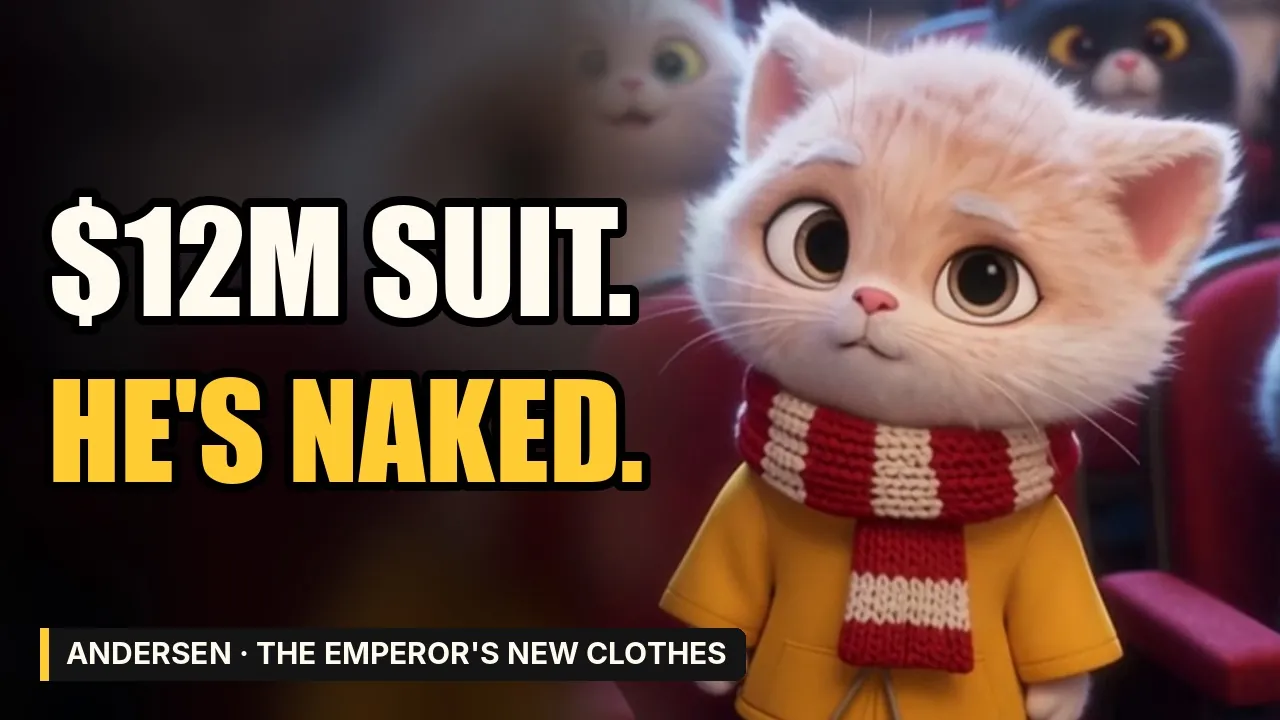
Our three-minute version turns the emperor into a billionaire who owns forty companies, three islands and two thousand suits. Two "founders" sell him an invisible suit for twelve million up front, plus a monthly subscription, plus cloud fees. The procession is a keynote, streamed live to forty million people.
The ending stays Andersen's: he knows they're right, and he walks on anyway.
Characters
- The emperor
- Vain, rich and more afraid of looking foolish than of being foolish.
- The two swindlers
- Con artists who understand that fear of embarrassment is more powerful than eyesight.
- The ministers and the crowd
- Everyone who sees nothing and says otherwise.
- The child
- The only one with nothing to lose by telling the truth.
Themes
Vanity
The emperor's love of appearances is exactly what the swindlers use against him.
Peer pressure
Everyone sees the same thing and nobody says it, because each person thinks they are the only one.
Truth
It takes a child, with no reputation to protect, to say what everyone knows.
The ending explained
The emperor realises the crowd is right but carries on with the procession anyway. Admitting the mistake would be even more embarrassing than walking on.
That last detail is what makes the story bite: being told the truth doesn't make people change course if their pride is at stake.
Questions students ask
What is the moral of The Emperor's New Clothes?
Don't let pride or the fear of looking foolish stop you from saying what you see. Also: a crowd agreeing with something doesn't make it true.
Who says the emperor has no clothes?
A small child in the crowd.
Why did nobody say anything before?
The swindlers claimed the cloth was invisible to anyone stupid or unfit for their job, so everyone was afraid to admit they couldn't see it.
When was The Emperor's New Clothes written?
It was published by Hans Christian Andersen in 1837.
Adapted from: The Emperor's New Clothes, Hans Christian Andersen (1837).
New classic every week, new Short every day
Twist endings from Chekhov, Poe, Premchand and more, acted by a troupe of plush cats.
Subscribe on YouTube