Edgar Allan Poe · 1843 · 4 min video
The Tell-Tale Heart by Edgar Allan Poe: Summary, Themes and Ending Explained
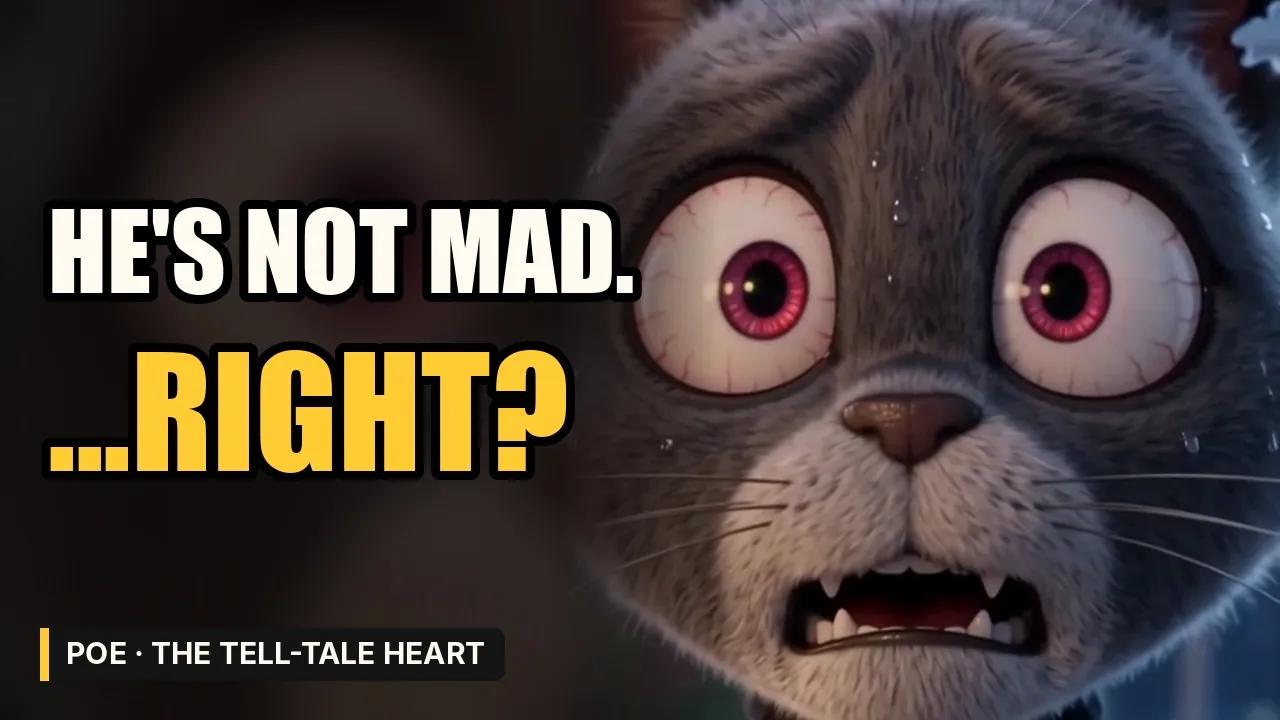
He insists he isn't mad. He loved the old man. It was only the eye. And then the heart wouldn't stop beating.
Summary of the original story
The narrator begins by insisting he is not mad, and offers to prove it by telling us calmly how he committed a murder.
He lives with an old man who has never wronged him. But the old man has a pale blue eye with a film over it, "the eye of a vulture", and the narrator cannot bear it. He decides to kill the old man and be rid of the eye forever.
For seven nights, at midnight, he opens the old man's door so slowly that it takes an hour, and shines a single thin ray of lantern light into the room. Each night the eye is closed, so he cannot do it: it is the eye he hates, not the man. Each morning he is especially kind to him.
On the eighth night his thumb slips on the lantern's tin fastening. The old man sits up, terrified, and groans. When the ray of light finally falls on the open eye, the narrator hears a low, quick sound: the old man's heart, beating louder and louder. Afraid the neighbours will hear it, he leaps into the room and smothers the old man under the heavy bed.
He cuts up the body and hides it under the floorboards. At 4 a.m. three police officers arrive, because a neighbour heard a shriek. The narrator welcomes them, shows them around and, feeling bold, puts his chair right over the spot where the body lies. Soon he hears a beating sound. It grows louder, he talks faster and louder to drown it out, and the officers just smile. Convinced they know and are mocking him, he screams that he admits the deed and tells them to tear up the planks: "It is the beating of his hideous heart!"
How our version is different
Our four-minute Halloween version stars Soot as the narrator and an old landlord cat with a vulture eye. His phone buzzes on the eighth night. The neighbour posts the shriek in the building group chat. The officers chat about parking and Halloween costumes while the beating gets louder.
We kept Poe's slow build to the breaking point, and added one quiet line at the very end about what the officers actually heard.
Characters
- The narrator (Soot)
- Unnamed in Poe. Calm, proud of how careful he is, and certain that being so careful proves he is sane.
- The old man (the landlord)
- Kind and harmless. His only crime, as far as we know, is his eye.
- The police officers
- Friendly and relaxed. Their smiles are what finally break the narrator.
Themes
Guilt
Nothing in the room gives the narrator away. His own conscience does. Whether the heartbeat is real or imagined, it is guilt he can't stop hearing.
Madness and denial
The more he insists he is sane, the less we believe him. Poe makes the reader the judge of a narrator who can't be trusted.
Obsession
A man is killed over an eye. Poe shows how one small fixation can take over a mind completely.
The ending explained
The narrator confesses because he can't stand the sound of the heart any longer. He is sure the police can hear it too, and that their calm smiles mean they are mocking him.
Most readers take the heartbeat as his guilt, or his mind, playing tricks on him. A dead heart can't beat. Some suggest he is hearing his own heart pounding. Either way, nothing outside his head ever gives him away.
Questions students ask
Why did the narrator kill the old man?
Because of the old man's eye, which he describes as pale blue with a film over it, like a vulture's. He says he loved the old man and had no other reason.
How many nights did the narrator watch the old man?
Eight. On the first seven the eye was closed. On the eighth night it was open, and he killed him.
Where did the narrator hide the body?
Under the floorboards of the old man's room.
Why did the narrator confess?
He heard what he believed was the old man's heart beating under the floor, louder and louder, and became convinced the police could hear it and were mocking him.
Is the narrator of The Tell-Tale Heart reliable?
No. He insists he is sane while describing an obsessive, motiveless murder, which is why he is one of the most famous unreliable narrators in literature.
Adapted from: The Tell-Tale Heart, Edgar Allan Poe (1843).
New classic every week, new Short every day
Twist endings from Chekhov, Poe, Premchand and more, acted by a troupe of plush cats.
Subscribe on YouTube